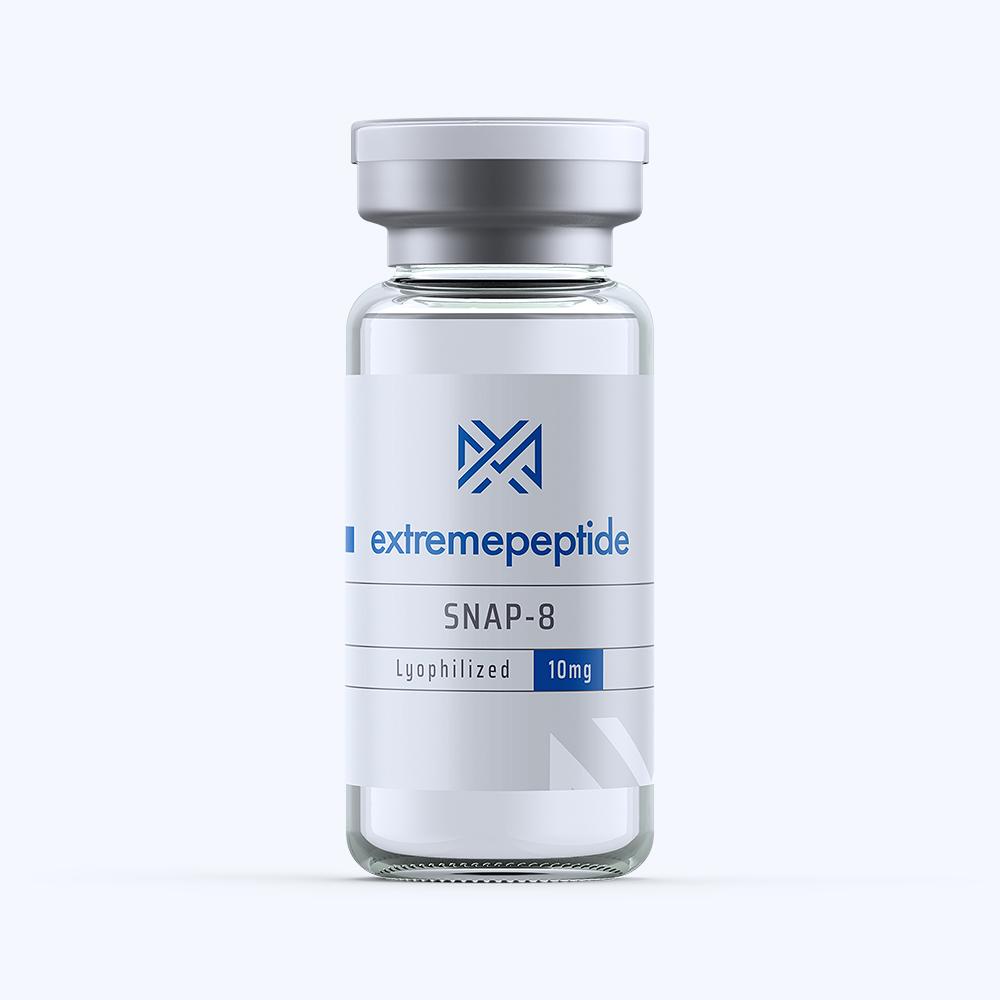
SNAP-8
The cosmetic peptide SNAP-8 is a truncated analogy of the naturally occurring peptide SNAP-25 – a perfect replica of its 8 N-terminal amino acids1. SNAP-25 takes a structurally important position of the SNARE complex family, a group of large proteins that play in important role in facial muscle contraction2. SNAP-8 was developed to outcompete SNAP-25 for its position in the SNARE complex, thereby causing a destabilization of the structure3. This destabilization does not allow the SNARE complex to function efficiently and thus interferes with its ability to initiate facial muscle contraction4.
Buy SNAP-8
SNAP-8 is termed a ‘cosmetic peptide’ because it has great potential to reduce facial wrinkle depth and to remove the appearance of age and stress from facial skin in animal test subjects. By limiting facial muscle contraction, SNAP-8 works against the reformation of facial wrinkles caused by facial expressions.
Product Comparison
Though biochemically dissimilar, researchers have found that the functionality of SNAP-8 is similar to that of Botulinum toxin (Botox)5 in that they both work to demobilize facial muscles and both lead to the development of smooth looking skin. The application of SNAP-8 is generally considered to be far less invasive and dangerous than Botox, and comes at a fraction of the price.
SNAP-8 has been frequently applied in combination with Lipopeptide in order to simultaneously defend against new wrinkle formation, to take action on any wrinkles present, and to stimulate the rejuvenation of the skin itself.
Synonyms:
SNAP-8; SNAP8; Soluble NSF Attachment Protein 8; Lipotec;
Peer-Reviewed Sources:
- Otto, H., Hanson, P. I., & Jahn, R. (1997). Assembly and disassembly of a ternary complex of synaptobrevin, syntaxin, and SNAP-25 in the membrane of synaptic vesicles.Proceedings of the National Academy of Sciences, 94(12), 6197-6201. ↩︎
- Jackson, M. B. (2010). SNARE complex zipping as a driving force in the dilation of proteinaceous fusion pores. Journal of Membrane Biology, 235(2), 89-100. ↩︎
- Łubkowska, B., Grobelna, B., & Maćkiewicz, Z. (2010). The use of synthetic polypeptides in cosmetics. Copernican Letters, 1, 75-82. ↩︎
- Reddy, B. Y., Jow, T., & Hantash, B. M. (2012). Bioactive oligopeptides in dermatology: Part II. Experimental dermatolog, 21(8), 569-575. ↩︎
- Adelson, R. T. (2007). Botulinum neurotoxins: fundamentals for the facial plastic surgeon. American journal of otolaryngology, 28(4), 260-266. ↩︎