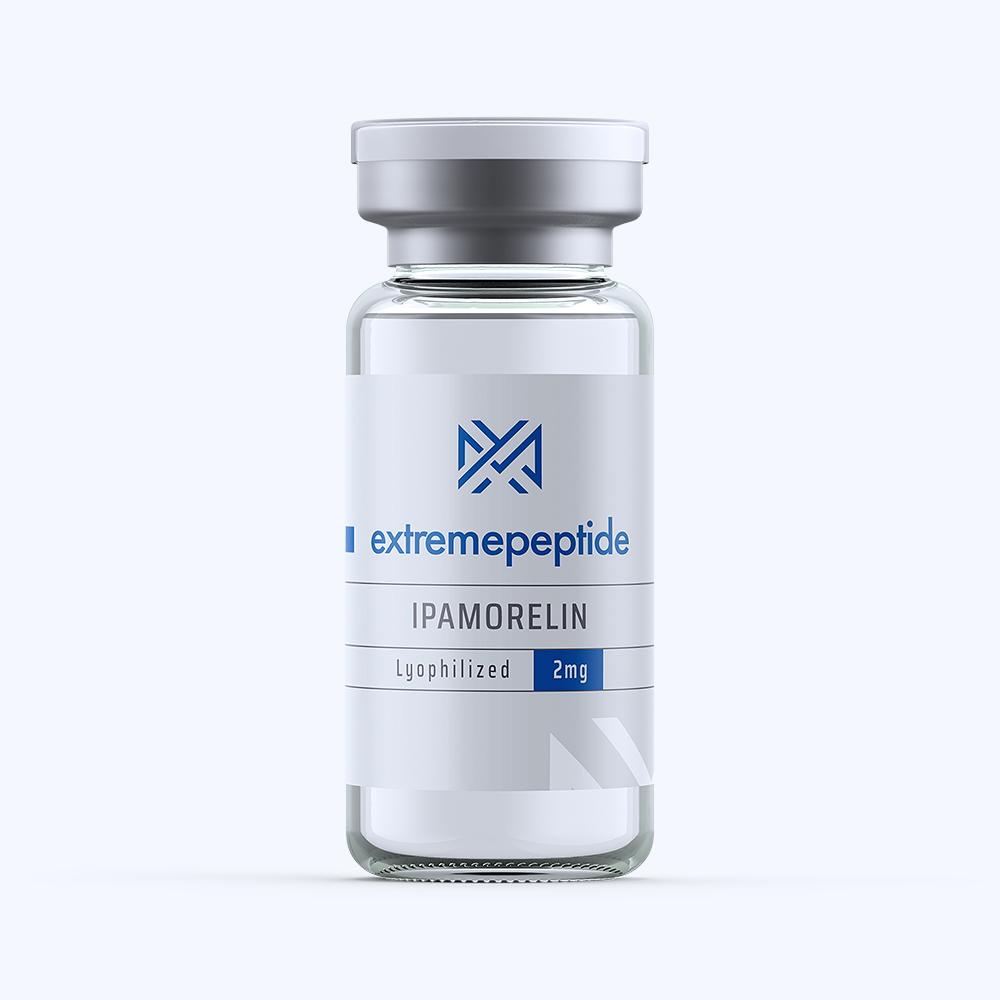
Ipamorelin
is a synthetic 5 amino acid sequence developed as a small molecule, chemically stabilized analogy to the naturally occurring protein ghrelin1. Ipamorelin is a member of a classification of agents called growth hormone (GH) secretagogues that were collectively developed in an effort to artificially stimulate the release of GH2. Ipamorelin is known to bind with the GH secretagogue receptor (ghrelin receptor) directly3, stimulating potent GH secretion in animal test subjects. Unlike its native analogy, ghrelin, Ipamorelin is a non-lipogenic peptide and suppresses somatostatin-induced regulation of GH production4.
buy Ipamorelin
The promotion of improved strength, increased muscle mass to body fat ratio, and the encouragement of good joint and connective tissue health has been observed in animal trials where high levels of GH release has been induced5. Ipamorelin, specifically, has been shown to also have a positive effect on bone growth in rats6.
Product Comparison
Similar to other agents of GH release, Ipamorelin acts on the anterior pituitary gland1. Ipamorelin’s mechanism of action is very similar to GHRP-2, being a ‘true’ GH secretagogue, reflecting its ability to stimulate the natural, body-mediated production of GH rather than introducing exogenous, synthetic agents to a physiological system.
Like GHRP-6 and GHRP-2, Ipamorelin acts synergistically with growth hormone releasing hormone (GHRH) or any of its analogies, like Sermorelin or CJC-1295, to achieve a very potent release of GH7. In light of this observation, it has been possible for researchers to administrate GHRH’s or GHRH analogies with Ipamorelin concurrently in order to achieve an additive positive effect on GH release.
Unlike GHRP-6 and GHRP-2, which are known to release prolactin and cortisol along with GH, Ipamorelin is specific in its release of GH through a broad spectrum of doses1.
The GHRP Family
The GHRP family of proteins is distinct from GHRH’s (or GHRFs) in that they share no sequence relation and derive their function through action at a completely different receptor, the ghrelin receptor8. The GHRP family is unique in that they lack opiate activity, though they are analogues of species that bear this quality2.
Synonyms:
Ipamorelin Acetate, IPAM, NNC-26-0161
Peer-Reviewed Sources:
- Raun, K., Hansen, B. S., Johansen, N. L., Thogersen, H., Madsen, K., Ankersen, M., & Andersen, P. H. (1998). Ipamorelin, the first selective growth hormone secretagogue. European Journal of Endocrinology, 139(5), 552-561. ↩︎
- Casanueva, F. F., & Dieguez, C. (1999). Growth hormone secretagogues: physiological role and clinical utility. Trends in Endocrinology & Metabolism,10(1), 30-38. ↩︎
- Holst, B., Cygankiewicz, A., Jensen, T. H., Ankersen, M., & Schwartz, T. W. (2003). High constitutive signaling of the ghrelin receptor—identification of a potent inverse agonist. Molecular Endocrinology, 17(11), 2201-2210. ↩︎
- Jiménez Reina, L., Cañete, R., De La Torre, M. J., & Bernal, G. (2002). Influence of chronic treatment with the growth hormone secretagogue Ipamorelin, in young female rats somatotroph response in vitro. ↩︎
- Jenkins, P. J. (1999). Growth hormone and exercise. Clinical endocrinology, 50(6), 683-689. ↩︎
- Johansen, P. B., Nowak, J., Skjærbæk, C., Flyvbjerg, A., Andreassen, T. T., Wilken, M., & Ørskov, H. (1999). Ipamorelin, a new growth-hormone-releasing peptide, induces longitudinal bone growth in rats. Growth Hormone & IGF Research, 9(2), 106-113. ↩︎
- Gobburu, J. V., Agersø, H., Jusko, W. J., & Ynddal, L. (1999). Pharmacokinetic-pharmacodynamic modeling of ipamorelin, a growth hormone releasing peptide, in human volunteers. Pharmaceutical research, 16(9), 1412-1416. ↩︎
- Granado, M., Priego, T., Martín, A. I., Villanua, M. A., & López-Calderón, A. (2005). Anti-inflammatory effect of the ghrelin agonist growth hormone-releasing peptide-2 (GHRP-2) in arthritic rats. American Journal of Physiology-Endocrinology and Metabolism, 288(3), E486-E492. ↩︎