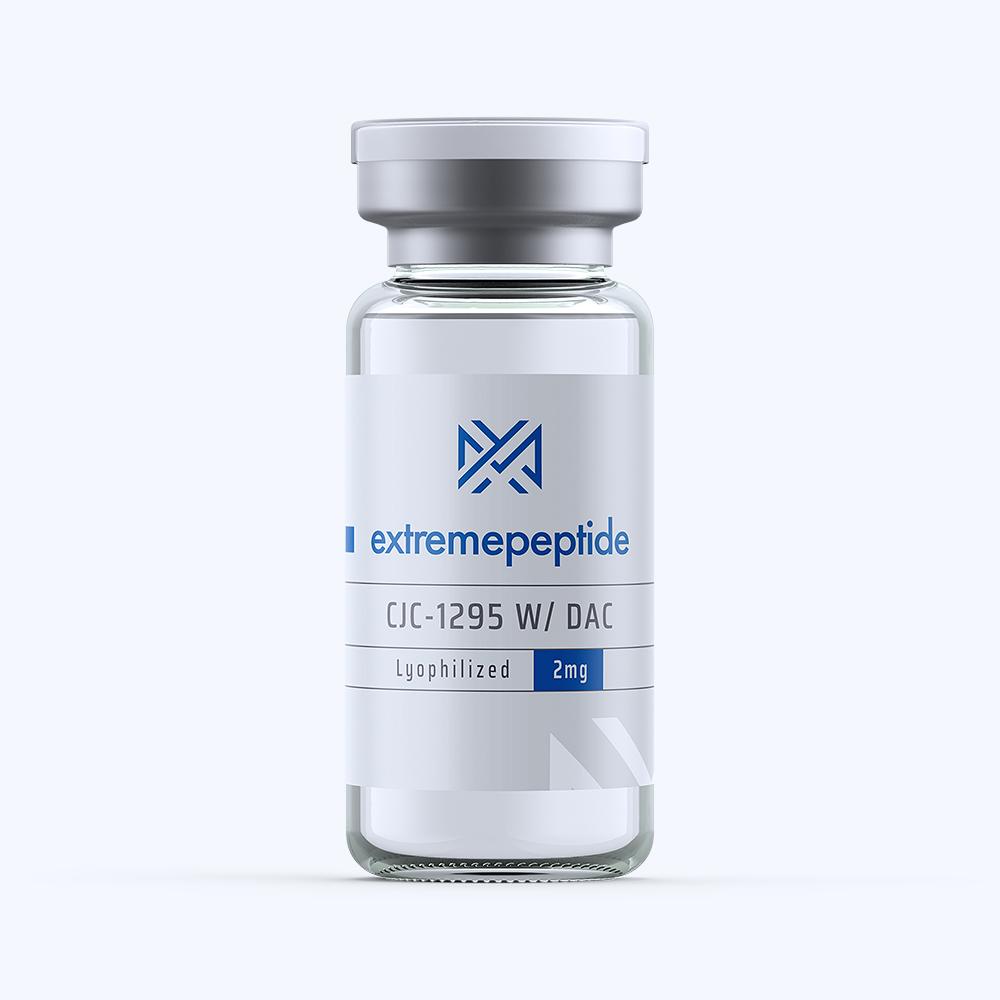
CJC-1295 WITH DAC
CJC-1295 DAC is a synthetic peptide developed to be an analogy of growth hormone releasing hormone (GHRH)1. The 29 amino acid sequence is derived from GRF(1-29), a naturally occurring growth hormone releasing factor CJC-1295 WITH DAC.
CJC-1295 DAC is reported to be a potent agent for the stimulation of long-term growth hormone (GH) and IGF-1 release2. These biochemical actions have been shown to result in the promotion of lean body mass, enhanced strength, increased appetite, and an improved quality of sleep in animal test subjects3.
BUY CJC-1295 WITH DAC
Though CJC-1295 DAC is an analogy of GRF(1-29) and acts to release GH through a similar pathway, CJC-1295 DAC benefits from a much improved half-life relative to its native counterpart4. By existing in the bloodstream for long periods of time before degradation, CJC-1295 DAC is able to promote sustained GH release.
In spite of having a similar site of action, CJC-1295 DAC (and CJC-1295 no DAC) does not stimulate GH production using the same biochemical pathway as the popular GH secretagogue GHRP-65. In light of this observation, it has been possible for researchers to administrate CJC-1295 species and GHRP-6 concurrently in order to achieve an additive positive effect on GH release CJC-1295 WITH DAC.
Drug Affinity Complex
The drug affinity complex (DAC) is a chemical group fixed to CJC-1295 that helps the peptide escape degradation by natural enzymes. By adding a component that gives CJC-1295 an affinity for albumin6, a naturally occurring protein in blood plasma, the peptide can achieve a much longer systemic half-life.
Preference for a long or short peptide half-life depends entirely on the research application of these agents.
Synonyms:
CJC-1295 DAC; Sermonil; Sermonil-CJC-1295 DAC; Sermorelin Maleimidopropionyl; Modified GRF 1-29 with DAC
Peer-Reviewed Sources:
- Sackmann-Sala, L., Ding, J., Frohman, L. A., & Kopchick, J. J. (2009). Activation of the GH/IGF-1 axis by CJC-1295, a long-acting GHRH analog, results in serum protein profile changes in normal adult subjects. Growth Hormone & IGF Research, 19(6), 471-477. ↩︎
- Teichman, S. L., Neale, A., Lawrence, B., Gagnon, C., Castaigne, J. P., & Frohman, L. A. (2006). Prolonged stimulation of growth hormone (GH) and insulin-like growth factor I secretion by CJC-1295, a long-acting analog of GH-releasing hormone, in healthy adults. The Journal of Clinical Endocrinology & Metabolism, 91(3), 799-805. ↩︎
- Alba, M., Fintini, D., Sagazio, A., Lawrence, B., Castaigne, J. P., Frohman, L. A., & Salvatori, R. (2006). Once-daily administration of CJC-1295, a long-acting growth hormone-releasing hormone (GHRH) analog, normalizes growth in the GHRH knockout mouse. American Journal of Physiology-Endocrinology and Metabolism, 291(6), E1290-E1294. ↩︎
- Jette, L., Leger, R., Thibaudeau, K., Benquet, C., Robitaille, M., Pellerin, I., … & Bridon, D. P. (2005). Human growth hormone-releasing factor (hGRF) 1–29-albumin bioconjugates activate the GRF receptor on the anterior pituitary in rats: Identification of CJC-1295 as a long-lasting GRF analog. Endocrinology,146(7), 3052-3058. ↩︎
- Cordido, F., Penalva, A., Dieguez, C., & Casanueva, F. F. (1993). Massive growth hormone (GH) discharge in obese subjects after the combined administration of GH-releasing hormone and GHRP-6: evidence for a marked somatotroph secretory capability in obesity. The Journal of Clinical Endocrinology & Metabolism, 76(4), 819-823. ↩︎
- Beals, J. M., & Shanafelt, A. B. (2006). Enhancing exposure of protein therapeutics. Drug Discovery Today: Technologies, 3(1), 87-94. ↩︎