Sale!

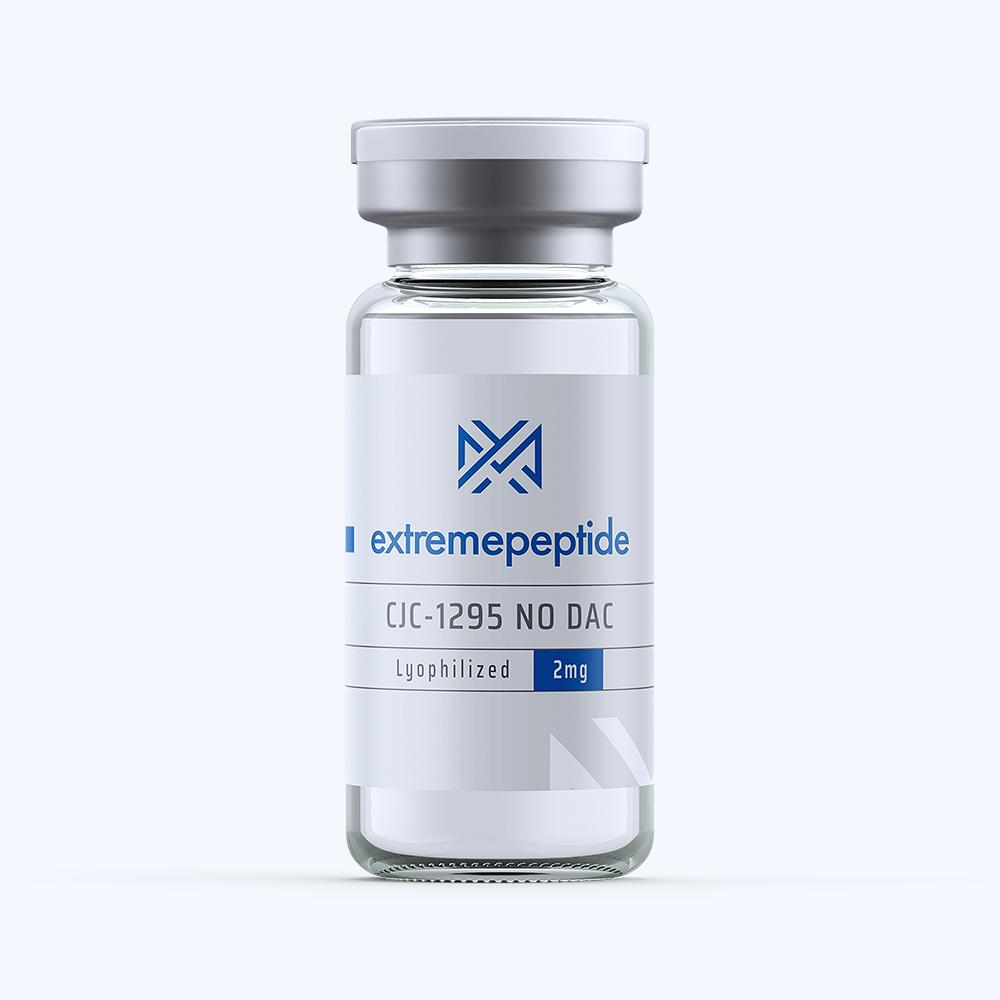
CJC-1295 NO-DAC (MOD GRF 1-29)

Original price was: $39.99.Current price is: $30.99.

& Free Shipping
SKU: EX1037-2MG Category:
Guaranteed Safe Checkout

CJC-1295 no DAC is a synthetic peptide developed to be an analogy of growth hormone releasing hormone (GHRH)1. The 29 amino acid sequence is derived from GRF(1-29), a naturally occurring growth hormone releasing factor. As its name implies, CJC-1295 no DAC lacks the ‘drug affinity complex’ described below2. This structural difference infers a shorter peptide half-life than its DAC-inclusive counterpart, which is elicits a GH release profile that more closely reflects what occurs in nature.

CJC-1295 no DAC is reported to be a potent agent for the stimulation of pulsatile growth hormone (GH) and IGF-1 release3. These biochemical actions have been shown to result in the promotion of lean body mass, enhanced strength, increased appetite, and an improved quality of sleep in animal test subjects4.

Product Comparison

In spite of having a similar site of action, CJC-1295 no DAC (and CJC-1295 with DAC) does not stimulate GH production using the same biochemical pathway as the popular GH secretagogue GHRP-65. In light of this observation, it has been possible for researchers to administrate CJC-1295 species and GHRP-6 concurrently in order to achieve an additive positive effect on GH release.

Drug Affinity Complex

The drug affinity complex (DAC) is a chemical group fixed to CJC-1295 DAC that helps the peptide escape degradation by natural enzymes. By adding a component that gives CJC-1295 an affinity for albumin2, a naturally occurring protein in blood plasma, the peptide can achieve a much longer systemic half-life.

Preference for a long or short peptide half-life depends entirely on the research application of these agents.

Synonyms:

CJC-1295; CJC-1295 no DAC; CJC-1295 without DAC; Modified Growth Releasing Factor aminos 1-29; Modified GRF (1-29); Mod GRF 1-29; Tetrasubstituted GRF (1-29);


Peer-Reviewed Sources:

  1. Sackmann-Sala, L., Ding, J., Frohman, L. A., & Kopchick, J. J. (2009). Activation of the GH/IGF-1 axis by CJC-1295, a long-acting GHRH analog, results in serum protein profile changes in normal adult subjects. Growth Hormone & IGF Research, 19(6), 471-477. ↩︎
  2. Beals, J. M., & Shanafelt, A. B. (2006). Enhancing exposure of protein therapeutics. Drug Discovery Today: Technologies, 3(1), 87-94. ↩︎
  3. Teichman, S. L., Neale, A., Lawrence, B., Gagnon, C., Castaigne, J. P., & Frohman, L. A. (2006). Prolonged stimulation of growth hormone (GH) and insulin-like growth factor I secretion by CJC-1295, a long-acting analog of GH-releasing hormone, in healthy adults. The Journal of Clinical Endocrinology & Metabolism, 91(3), 799-805. ↩︎
  4. Alba, M., Fintini, D., Sagazio, A., Lawrence, B., Castaigne, J. P., Frohman, L. A., & Salvatori, R. (2006). Once-daily administration of CJC-1295, a long-acting growth hormone-releasing hormone (GHRH) analog, normalizes growth in the GHRH knockout mouse. American Journal of Physiology-Endocrinology and Metabolism, 291(6), E1290-E1294. ↩︎
  5. Cordido, F., Penalva, A., Dieguez, C., & Casanueva, F. F. (1993). Massive growth hormone (GH) discharge in obese subjects after the combined administration of GH-releasing hormone and GHRP-6: evidence for a marked somatotroph secretory capability in obesity. The Journal of Clinical Endocrinology & Metabolism, 76(4), 819-823. ↩︎
CID

56841945

InChI

InChI=1S/C152H252N44O42/c1-22-79(15)118(194-125(214)84(20)171-135(224)107(68-115(206)207)181-124(213)81(17)169-126(215)91(155)65-87-41-45-89(201)46-42-87)147(236)189-106(66-86-34-25-24-26-35-86)141(230)196-120(85(21)200)149(238)180-99(51-54-114(158)205)132(221)190-111(72-199)145(234)185-105(67-88-43-47-90(202)48-44-88)140(229)178-96(40-33-59-168-152(164)165)128(217)177-94(37-28-30-56-154)133(222)193-117(78(13)14)146(235)187-100(60-73(3)4)134(223)170-82(18)123(212)175-97(49-52-112(156)203)130(219)183-103(63-76(9)10)138(227)191-109(70-197)143(232)172-83(19)122(211)174-95(39-32-58-167-151(162)163)127(216)176-93(36-27-29-55-153)129(218)182-102(62-75(7)8)137(226)184-101(61-74(5)6)136(225)179-98(50-53-113(157)204)131(220)186-108(69-116(208)209)142(231)195-119(80(16)23-2)148(237)188-104(64-77(11)12)139(228)192-110(71-198)144(233)173-92(121(159)210)38-31-57-166-150(160)161/h24-26, 34-35, 41-48, 73-85, 91-111, 117-120, 197-202H, 22-23, 27-33, 36-40, 49-72, 153-155H2, 1-21H3, (H2, 156, 203)(H2, 157, 204)(H2, 158, 205)(H2, 159, 210)(H, 169, 215)(H, 170, 223)(H, 171, 224)(H, 172, 232)(H, 173, 233)(H, 174, 211)(H, 175, 212)(H, 176, 216)(H, 177, 217)(H, 178, 229)(H, 179, 225)(H, 180, 238)(H, 181, 213)(H, 182, 218)(H, 183, 219)(H, 184, 226)(H, 185, 234)(H, 186, 220)(H, 187, 235)(H, 188, 237)(H, 189, 236)(H, 190, 221)(H, 191, 227)(H, 192, 228)(H, 193, 222)(H, 194, 214)(H, 195, 231)(H, 196, 230)(H, 206, 207)(H, 208, 209)(H4, 160, 161, 166)(H4, 162, 163, 167)(H4, 164, 165, 168)/t79-, 80-, 81+, 82-, 83-, 84-, 85+, 91-, 92-, 93-, 94-, 95-, 96-, 97-, 98-, 99-, 100-, 101-, 102-, 103-, 104-, 105-, 106-, 107-, 108-, 109-, 110-, 111-, 117-, 118-, 119-, 120-/m0/s1

InChIKey

XOZMWINMZMMOBR-HRDSVTNWSA-N

Isomeric SMILES

CC[C@H](C)[C@@H](C(=O)N[C@@H](CC1=CC=CC=C1)C(=O)N[C@@H]([C@@H](C)O)C(=O)N[C@@H](CCC(=O)N)C(=O)N[C@@H](CO)C(=O)N[C@@H](CC2=CC=C(C=C2)O)C(=O)N[C@@H](CCCNC(=N)N)C(=O)N[C@@H](CCCCN)C(=O)N[C@@H](C(C)C)C(=O)N[C@@H](CC(C)C)C(=O)N[C@@H](C)C(=O)N[C@@H](CCC(=O)N)C(=O)N[C@@H](CC(C)C)C(=O)N[C@@H](CO)C(=O)N[C@@H](C)C(=O)N[C@@H](CCCNC(=N)N)C(=O)N[C@@H](CCCCN)C(=O)N[C@@H](CC(C)C)C(=O)N[C@@H](CC(C)C)C(=O)N[C@@H](CCC(=O)N)C(=O)N[C@@H](CC(=O)O)C(=O)N[C@@H]([C@@H](C)CC)C(=O)N[C@@H](CC(C)C)C(=O)N[C@@H](CO)C(=O)N[C@@H](CCCNC(=N)N)C(=O)N)NC(=O)[C@H](C)NC(=O)[C@H](CC(=O)O)NC(=O)[C@@H](C)NC(=O)[C@H](CC3=CC=C(C=C3)O)N

Canonical SMILES

CCC(C)C(C(=O)NC(CC1=CC=CC=C1)C(=O)NC(C(C)O)C(=O)NC(CCC(=O)N)C(=O)NC(CO)C(=O)NC(CC2=CC=C(C=C2)O)C(=O)NC(CCCNC(=N)N)C(=O)NC(CCCCN)C(=O)NC(C(C)C)C(=O)NC(CC(C)C)C(=O)NC(C)C(=O)NC(CCC(=O)N)C(=O)NC(CC(C)C)C(=O)NC(CO)C(=O)NC(C)C(=O)NC(CCCNC(=N)N)C(=O)NC(CCCCN)C(=O)NC(CC(C)C)C(=O)NC(CC(C)C)C(=O)NC(CCC(=O)N)C(=O)NC(CC(=O)O)C(=O)NC(C(C)CC)C(=O)NC(CC(C)C)C(=O)NC(CO)C(=O)NC(CCCNC(=N)N)C(=O)N)NC(=O)C(C)NC(=O)C(CC(=O)O)NC(=O)C(C)NC(=O)C(CC3=CC=C(C=C3)O)N

IUPAC Name

(3S)-4-[[(2S)-1-[[(2S, 3S)-1-[[(2S)-1-[[(2S, 3R)-1-[[(2S)-5-amino-1-[[(2S)-1-[[(2S)-1-[[(2S)-1-[[(2S)-6-amino-1-[[(2S)-1-[[(2S)-1-[[(2S)-1-[[(2S)-5-amino-1-[[(2S)-1-[[(2S)-1-[[(2S)-1-[[(2S)-1-[[(2S)-6-amino-1-[[(2S)-1-[[(2S)-1-[[(2S)-5-amino-1-[[(2S)-1-[[(2S, 3S)-1-[[(2S)-1-[[(2S)-1-[[(2S)-1-amino-5-carbamimidamido-1-oxopentan-2-yl]amino]-3-hydroxy-1-oxopropan-2-yl]amino]-4-methyl-1-oxopentan-2-yl]amino]-3-methyl-1-oxopentan-2-yl]amino]-3-carboxy-1-oxopropan-2-yl]amino]-1, 5-dioxopentan-2-yl]amino]-4-methyl-1-oxopentan-2-yl]amino]-4-methyl-1-oxopentan-2-yl]amino]-1-oxohexan-2-yl]amino]-5-carbamimidamido-1-oxopentan-2-yl]amino]-1-oxopropan-2-yl]amino]-3-hydroxy-1-oxopropan-2-yl]amino]-4-methyl-1-oxopentan-2-yl]amino]-1, 5-dioxopentan-2-yl]amino]-1-oxopropan-2-yl]amino]-4-methyl-1-oxopentan-2-yl]amino]-3-methyl-1-oxobutan-2-yl]amino]-1-oxohexan-2-yl]amino]-5-carbamimidamido-1-oxopentan-2-yl]amino]-3-(4-hydroxyphenyl)-1-oxopropan-2-yl]amino]-3-hydroxy-1-oxopropan-2-yl]amino]-1, 5-dioxopentan-2-yl]amino]-3-hydroxy-1-oxobutan-2-yl]amino]-1-oxo-3-phenylpropan-2-yl]amino]-3-methyl-1-oxopentan-2-yl]amino]-1-oxopropan-2-yl]amino]-3-[[(2R)-2-[[(2S)-2-amino-3-(4-hydroxyphenyl)propanoyl]amino]propanoyl]amino]-4-oxobutanoic acid

Molecular Formula

C152H252N44O42

Molecular Weight

3367.9

Monoisotopic Mass

3365.8935782

Polar Area

1450

Complexity

7710

XLogP

-10.7

Heavy Atom Count

238

Hydrogen Bond Donor Count

52

Hydrogen Bond Acceptor Count

48

Rotatable Bond Count

118

Physical Appearance

Fine White Lyophilized Powder

Stability

Lyophilized protein is to be stored at -20°C. It is recommended to aliquot the reconstituted (dissolved) protein into several discrete vials in order to avoid repeated freezing and thawing. Reconstituted protein can be stored at 4°C

CAS

446262-90-4