GHRP-6
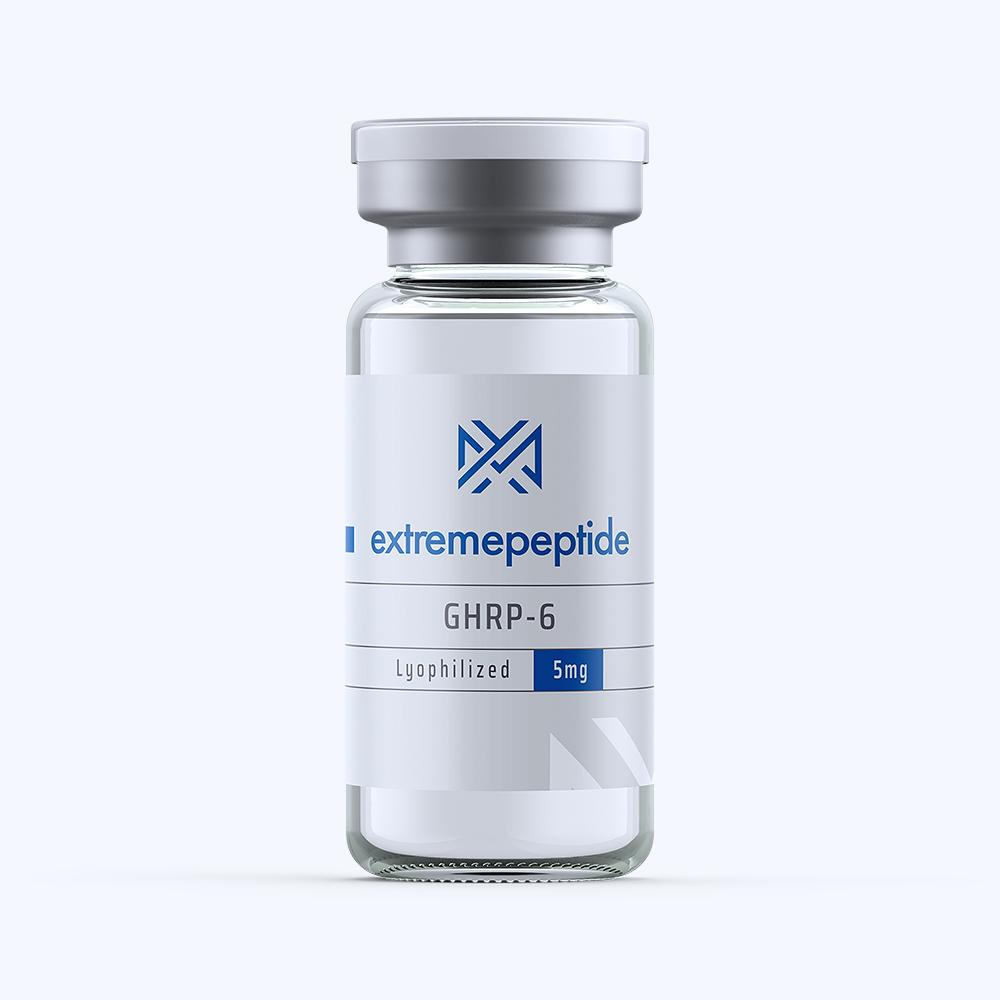
Growth Hormone Releasing Peptide 6 (GHRP-6) is a synthetic, 6-amino acid sequence, which is analogous to the naturally occurring protein met-enkephalin1. GHRP-6 is a member of a classification of agents called growth hormone (GH) secretagogues that were collectively developed in an effort to artificially stimulate the release of GH2. GHRP-6 is known to bind with the GH secretagogue receptor (ghrelin receptor) directly3, stimulating potent GH secretion and appetite in animal test subjects2.
Buy GHRP-6
The promotion of improved strength, increased muscle mass to body fat ratio, and the encouragement of good joint and connective tissue health has been observed in animal trials4.
Product Comparison
Similar to other agents of GH release, GHRP-6 acts on the anterior pituitary gland5. In spite of having a similar site of action, GHRP-6 does not stimulate GH production using the same biochemical pathway as the popular GH secretagogue ‘sermorelin’ its analogues, like CJC-12956. In light of this observation, it has been possible for researchers to administrate CJC-1295 and GHRP-6 concurrently in order to achieve an additive positive effect on GH release. A similar synergistic relationship has been documented with insulin, where much improved GH release was observed in animal trials following a concurrent dosing scheme7.
The GHRP Family
The GHRP family of proteins is distinct from growth hormone releasing hormones (GHRH or GHRF) in that they share no sequence relation and derive their function through action at a completely different receptor, the ghrelin receptor8. The GHRP family is unique in that they lack opiate activity, though they are analogues of species that bear this quality9.
Synonyms:
Growth Hormone Releasing Peptide-6; Growth hormone releasing hexapeptide; Somacrin; Somatocrinin-6; RP6;
Peer-Reviewed Sources:
- McDowell RS, Elias KA, Stanley MS, Burdick DJ, Burnier JP, Chan KS, Fairbrother WJ, Hammonds RG, Ingle GS, Jacobsen NE (1995). Growth hormone secretagogues: characterization, efficacy, and minimal bioactive conformation. Proc Natl Acad Sci USA, 92:11165-11169. ↩︎
- Fairhall, K. M., Mynett, A., & Robinson, I. C. A. F. (1995). Central effects of growth hormone-releasing hexapeptide (GHRP-6) on growth hormone release are inhibited by central somatostatin action. Journal of Endocrinology, 144(3), 555-560. ↩︎
- Muccioli, G., Ghe, C., Ghigo, M. C., Papotti, M., Arvat, E., Boghen, M. F., Nilsson, H., Deghenghi, R., Ong, H., & Ghigo, E. (1998). Specific receptors for synthetic GH secretagogues in the human brain and pituitary gland. Journal of Endocrinology, 157(1), 99-106. ↩︎
- Cella, S. G., Cerri, C. G., Daniel, S., Sibilia, V., Rigamonti, A., Cattaneo, L., Deghenghi, R., & Müller, E. E. (1996). Sixteen weeks of hexarelin therapy in aged dogs: effects on the somatotropic axis, muscle morphology, and bone metabolism. The Journals of Gerontology Series A: Biological Sciences and Medical Sciences, 51(6), B439-B447. ↩︎
- Mau, S. E., Witt, M. R., Bjerrum, O. J., Særmark, T., & Vilhardt, H. (1995). Growth hormone releasing hexapeptide (GHRP-6) activates the inositol (1, 4, 5)-trisphosphate/diacylglycerol pathway in rat anterior pituitary cells. Journal of Receptors and Signal Transduction,15(1-4), 311-323. ↩︎
- Cordido, F., Penalva, A., Dieguez, C., & Casanueva, F. F. (1993). Massive growth hormone (GH) discharge in obese subjects after the combined administration of GH-releasing hormone and GHRP-6: evidence for a marked somatotroph secretory capability in obesity. The Journal of Clinical Endocrinology & Metabolism, 76(4), 819-823. ↩︎
- Penalva, A., Carballo, A., Pombo, M., Casanueva, F. F., & Dieguez, C. (1993). Effect of growth hormone (GH)-releasing hormone (GHRH), atropine, pyridostigmine, or hypoglycemia on GHRP-6-induced GH secretion in man. The Journal of Clinical Endocrinology & Metabolism, 76(1), 168-171. ↩︎
- Granado, M., Priego, T., Martín, A. I., Villanua, M. A., & López-Calderón, A. (2005). Anti-inflammatory effect of the ghrelin agonist growth hormone-releasing peptide-2 (GHRP-2) in arthritic rats. American Journal of Physiology-Endocrinology and Metabolism, 288(3), E486-E492. ↩︎
- Casanueva, F. F., & Dieguez, C. (1999). Growth hormone secretagogues: physiological role and clinical utility. Trends in Endocrinology & Metabolism,10(1), 30-38. ↩︎