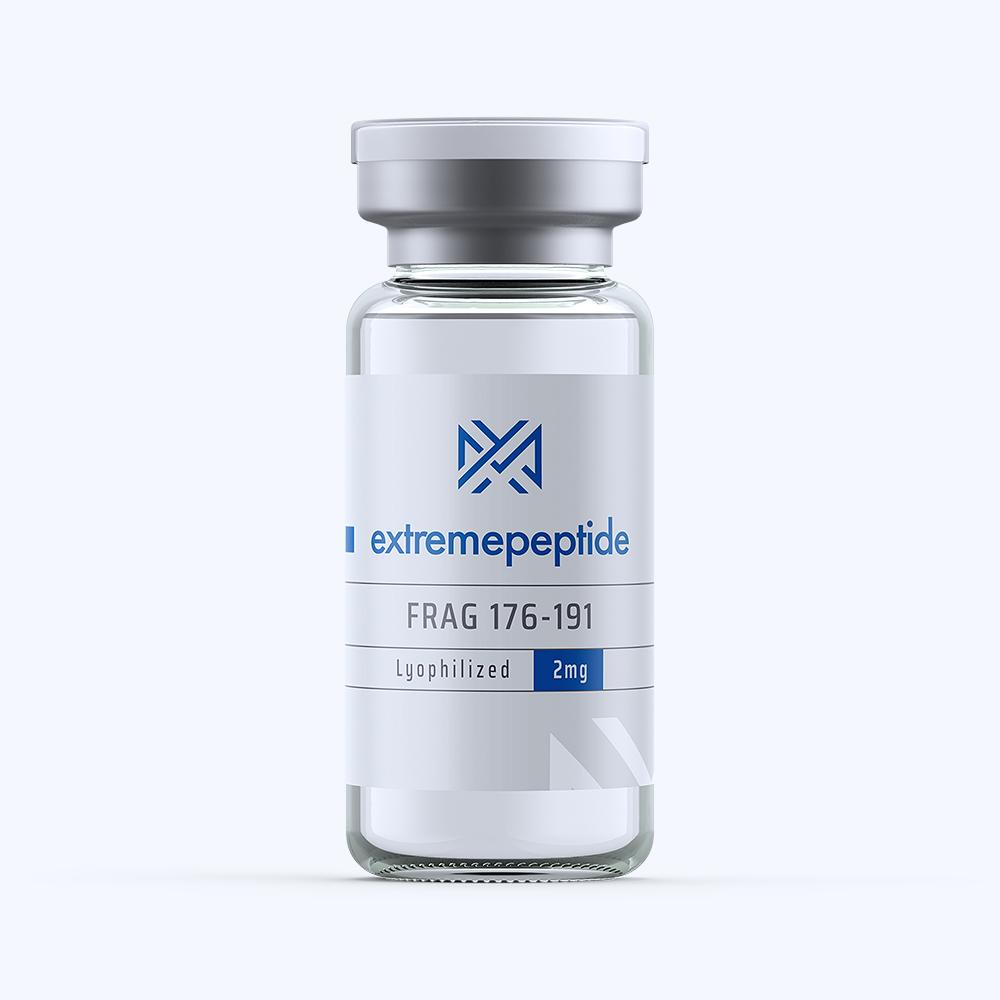
Fragment 176-191
Fragment 176-191 is a 16 amino acid fragment of the much larger growth hormone (GH) peptide1. This particular GH fragment was isolated and biosynthesized in order to develop a lipolytic (fat cell destroying) and lipogenic (preventing the accumulation of body fat) agent2 without stimulating effects on growth and insulin resistance, which GH has been shown to do in animal test subjects3.
Buy Fragment 176-191
Fragment 176-191 functions by emulating the way native GH manages fat metabolism Regular administration of Fragment 176-191 has been shown to reduce body fat levels in mice that were obese, mildly overweight, and of average body types4. While burning fat and preventing storage of additional fat stores, Fragment 176-191 showed no effect on the consumption habits of test animals5.
Product Comparison
Since Fragment 176-191 is a fragment of the larger GH peptide, its similarities in structure and in function are distinct. Fragment 176-191 was developed from the C-terminal end of GH, which was observed to be the end active in fat management. The remaining amino acids present in GH are those responsible for activity in growth, IGF production, and muscle mass development, which are functionalities also conserved in GH secretagogues like Hexarelin6 and Sermorelin7. Since Fragment 176-191 only retains the 16 amino acids present in the C-terminal end, it acts as a singular, very effect agent for the reduction of excess adipose tissue. Fragment 176-191 is very similar in character to AOD9604, or hGH Fragment 177-1918. They each have lipolytic and anti-lipogenic actions, but researchers have developed colloquial preferences in each direction. Some have reported a longer lasting fat-burning effect in AOD9604, while Fragment 176-191 demonstrates an excellent peak rate of lipolysis. Preference between the two agents must be determined by the research goal.
Synonyms:
hGH Fragment 176-191; HGH 176-191;
Peer-Reviewed Sources:
- Ng, F. M., Sun, J., Sharma, L., Libinaka, R., Jiang, W. J., & Gianello, R. (1999). Metabolic studies of a synthetic lipolytic domain of human growth hormone. Hormone research, 53(6), 274-278. ↩︎
- Heffernan, M., Summers, R. J., Thorburn, A., Ogru, E., Gianello, R., Jiang, W. J., & Ng, F. M. (2001). The Effects of Human GH and Its Lipolytic Fragment on Lipid Metabolism Following Chronic Treatment in Obese Mice andβ 3-AR Knock- Out Mice. Endocrinology, 142(12), 5182-5189. ↩︎
- Pöykkö, S. M., Kellokoski, E., Hörkkö, S., Kauma, H., Kesäniemi, Y. A., & Ukkola, O. (2003). Low plasma ghrelin is associated with insulin resistance, hypertension, and the prevalence of type 2 diabetes. Diabetes, 52(10), 2546- 2553. ↩︎
- Heffernan, M. A., Thorburn, A. W., Fam, B., Summers, R., Conway-Campbell, B., Waters, M. J., & Ng, F. M. (2001). Increase of fat oxidation and weight loss in obese mice caused by chronic treatment with human growth hormone or a modified C-terminal fragment. International journal of obesity and related metabolic disorders: journal of the International Association for the Study of Obesity, 25(10), 1442-1449. ↩︎
- Atkinson, T. J. (2008). Central and peripheral neuroendocrine peptides and signalling in appetite regulation: considerations for obesity pharmacotherapy. Obesity reviews, 9(2), 108-120. ↩︎
- Deghenghi, R., Cananzi, M. M., Torsello, A., Battisti, C., Muller, E. E., & Locatelli, V. (1994). GH-releasing activity of hexarelin, a new growth hormone releasing peptide, in infant and adult rats. Life sciences, 54(18), 1321-1328. ↩︎
- Prakash, Amitabh, and Karen L. Goa. “Sermorelin.” BioDrugs 12.2 (1999): 139-157. ↩︎
- Wu, Z. & Ng, FM. (1993) Antilipogenic action of synthetic C-terminal sequence 177-191 of human growth hormone. Biochemistry and molecular biology international journal. 5(2), 1281-1327. ↩︎