Hexarelin
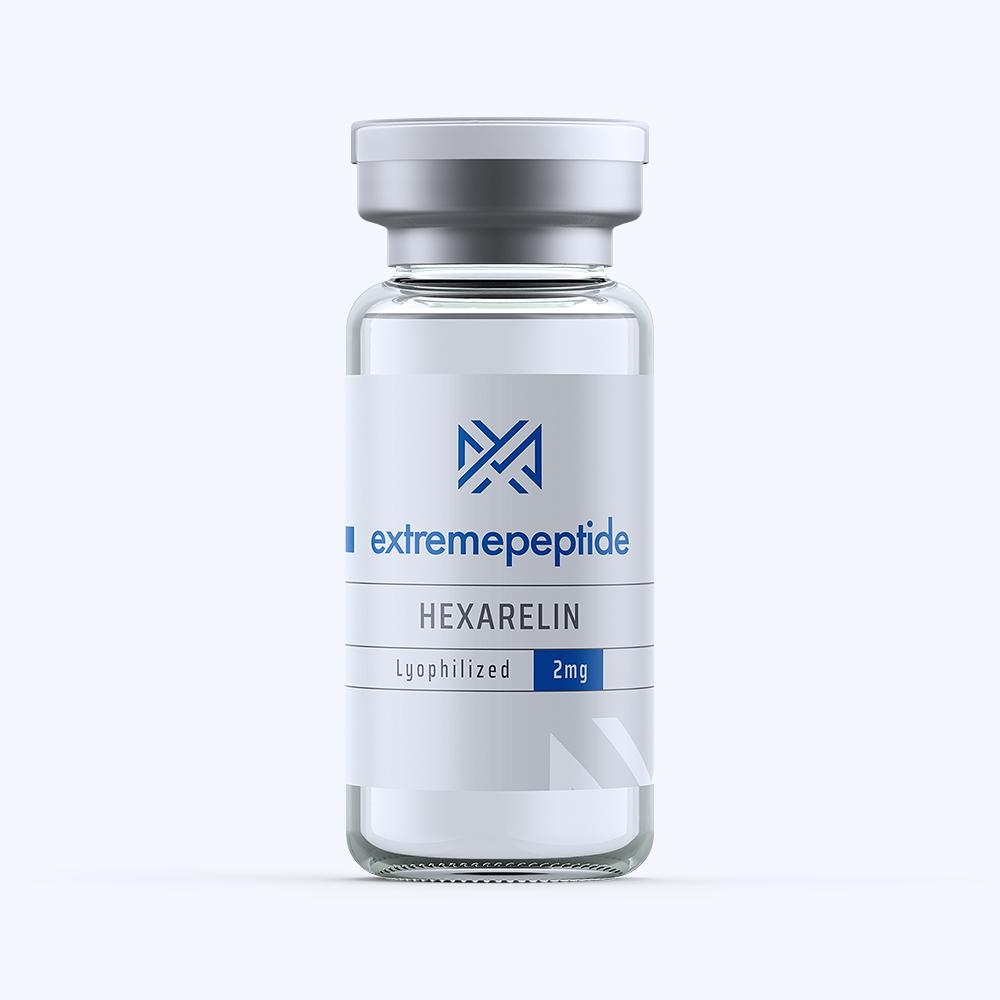
Hexarelin is a growth hormone (GH) releasing peptide (GHRP) analog comprised of 6 amino acid residues and having a methylated ‘Trp’ terminus in order to enhance structural stability and to prolong residence time in the bloodstream1. Earning it the classification of a GH secretagogue (GHS), Hexarelin has been found to promote the production of GH by binding to the GHS (ghrelin) receptor within the pituitary gland and the hypothalamus2.
buy Hexarelin
Hexarelin is reported to be a potent agent for the stimulation of GH production, which has been shown to be a promoter of enhanced muscle strength, increased muscle mass, improved joint health, quickened wound healing3, and damage protection threatened by cardiac dysfunction4. Animal testing has demonstrated that Hexarelin stimulates also significant secretion of IGF-1, PRL, ACTH, and cortisol5, while not to inducing appetite and gastric emptying, which is a property of other GHRP analogs6.
Product Comparison
The regular administration of endogenous, synthetic GH has the potential to cause a parallel reduction of natural GH production as a result of modulation by somatostatin5, which may run counter to desired research outcomes. Rather than using synthetic GH to substitute production of the naturally occurring agent, Hexarelin promotes natural GH production alongside normal, systemic production
Hexarelin and GHRP-6 are noted to have similar capabilities in stimulating sustained GH release, but, as mentioned above, Hexarelin lacks GHRP-6’s appetite inducing properties6.
Synonyms:
Hexarelin Acetate, HEX, Examorelin
Peer-Reviewed Sources:
- Torsello, A., Luoni, M., Schweiger, F., Grilli, R., Guidi, M., Bresciani, E., … & Locatelli, V. (1998). Novel hexarelin analogs stimulate feeding in the rat through a mechanism not involving growth hormone release. European journal of pharmacology, 360(2), 123-129. ↩︎
- Deghenghi, R., Cananzi, M. M., Torsello, A., Battisti, C., Muller, E. E., & Locatelli, V. (1994). GH-releasing activity of hexarelin, a new growth hormone releasing peptide, in infant and adult rats. Life sciences, 54(18), 1321-1328. ↩︎
- Acosta, J. B., Vera, D. C., Herrera, D. G. D. B., Nieto, G. E. G., Alba, J. S., Mola, E. L., & Castillo, M. V. (2011). Pharmaceutical Composition Containing GHRP-6 To Prevent And Eliminate Fibrosis And Other Pathological Deposits In Tissues. U.S. Patent Application 13/150,526. ↩︎
- Locatelli, V., Rossoni, G., Schweiger, F., Torsello, A., De Gennaro Colonna, V., Bernareggi, M., & Berti, F. (1999). Growth Hormone-Independent Cardioprotective Effects of Hexarelin in the Rat 1. Endocrinology, 140(9), 4024-4031. ↩︎
- Arvat, E., Maccario, M., Di Vito, L., Broglio, F., Benso, A., Gottero, C., & Ghigo, E. (2001). Endocrine activities of ghrelin, a natural growth hormone secretagogue (GHS), in humans: comparison and interactions with hexarelin, a nonnatural peptidyl GHS, and GH-releasing hormone 1. The Journal of Clinical Endocrinology & Metabolism, 86(3), 1169-1174. ↩︎
- Schmid, D. A., Held, K., Ising, M., Uhr, M., Weikel, J. C., & Steiger, A. (2005). Ghrelin stimulates appetite, imagination of food, GH, ACTH, and cortisol, but does not affect leptin in normal controls. Neuropsychopharmacology, 30(6), 1187-1192. ↩︎